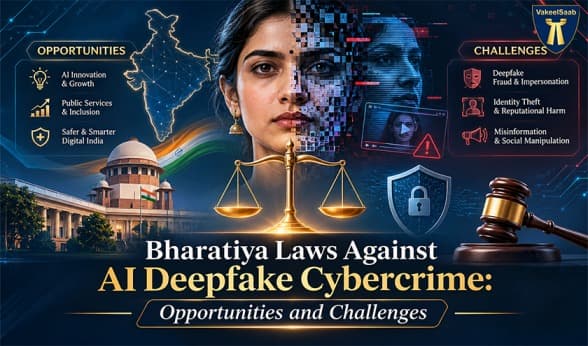
The image of a person who did not film it shows up in an explicit video. Someone’s voice calls their relative, demanding that they make a quick transfer, but the voice belongs to an artificially intelligent clone. A video that defames someone pops up on the internet without them even knowing about it.
The menace posed by the creation of deepfakes using AI does not only arise from what is possible through technology but also from how soon the fake identity can actually pose physical danger to an individual.
There is no single law that deals specifically with deepfakes in India. But there are other existing laws and some amendments that can be made in the Information Technology Rules of 2026 that can effectively tackle different instances of misuse. This will assist individuals in securing their identities against any unlawful use.
What Are AI Deepfakes and How Are They Misused?
AI Deepfakes are audio, image, and video files that have been altered or created using technology to create the impression of something that is real but may not be. With the use of artificial intelligence, an individual can mimic the face or voice of another person.
The misuse can take several forms:
- Fake videos: Putting someone’s face into a video of things that never took place.
- Voice cloning: Mimicking a person’s voice to deceive people like family members, colleagues or customers.
- Non-consensual intimate imagery: Creating explicit images of someone using their image.
- Identity impersonation: Making fake profiles or ads by using the identity of someone else.
- Misinformation: Misleading viewers using manipulated public statements or events.
Victims may experience humiliation as well as other problems like financial damage, harassment, defamation of character, and invasion of privacy.
Is Creating or Sharing Deepfake Content Illegal in India?
Creating an AI-generated image or video does not constitute an offence under the law per se in India. This will depend upon what is portrayed, whose identity is used, whether consent is taken, and how the content is generated and shared.
For instance, the use of AI in creating a fictional character or a parody would not result in criminal culpability. However, the use of another person's identity for fraud, posting manipulated sexual images or knowingly distributing defamatory content can have legal implications.
The distinction matters: A person could find themselves being held legally liable not just for their use of artificial intelligence, but for doing something illegal with it.
What Laws in India Apply to AI Deepfakes?
Though there is no unified deepfake legislation, the Information Technology Act, 2000 and the Bharatiya Nyaya Sanhita, 2023 offer important legal avenues in light of the actions taken.
1. Information Technology Act, 2000
The IT Act addresses several forms of digital misuse:
Provision | How it may apply |
Section 66C | Fraudulent use of another person's electronic signature, password or unique identification feature. |
Section 66D | Cheating by impersonating another person through a computer resource. |
Section 66E | Capturing, publishing or transmitting images of a person's private areas without consent in circumstances violating privacy. |
Section 67 | Publishing or transmitting obscene material electronically. |
Section 67A | Publishing or transmitting sexually explicit material electronically. |
Section 67B | Material depicting children in sexually explicit acts or conduct. |
Section 79 | Conditional protection for intermediaries complying with statutory due-diligence requirements. |
For example, the person using a voice cloned by AI technology to fraudulently impersonate a bank employee may come under Section 66D. Likewise, disseminating explicit material of such a nature may be punishable under Section 67A or 67B.
2. Bharatiya Nyaya Sanhita, 2023
Deepfake misuse may amount to an offence in the BNS if the offences are other than those relating to the deepfake technology.
- Section 318 - Cheating: This section is applicable if there is deception of another person through the use of the manipulated content causing wrongful loss/gain to another person.
- Section 319 - Cheating by personation: This section is applicable if a person fraudulently impersonates another person.
- Section 336 - Forgery: Applicable where the act falls within the required elements of forgery of a document or electronic record.
- Section 353 - Statements conducing to public mischief: Applicable to statements, rumours, or reports satisfying the statutory requirement that causes the prescribed public mischief.
- Section 356 - Defamation: Applicable if there is defamation due to the fabrication of content and it satisfies the statutory elements of the offence.
The relevant offence will depend on the specific evidence and circumstances; these provisions should not automatically apply to all deepfakes.
3. Other Legal Protections
Constitutional provision of Article 21 guarantees the right to privacy and dignity. Similarly, personality rights can be used by individuals against unauthorised use of their identity by commercial enterprises.
Digital Personal Data Protection Act, 2023 can come into application where identifiable digital personal data is processed under its ambit. Its application should be considered in light of the phased implementation of its provisions.
Bharatiya Sakshya Adhiniyam, 2023 is equally applicable when it comes to proving the genuineness and relevance of electronic evidence in court proceedings.
What Do the 2026 IT Rules Say About AI-Generated Content and Deepfakes?
Fake videos are capable of reaching thousands of individuals prior to being detected. In order to counter this problem. The government made modifications to the Information Technology (Intermediary Guidelines and Digital Media Ethics Code) Rules, 2021 via the notification dated February 10, 2026.
The amendments contain provisions for the treatment of synthetically generated information (SGI), namely:
- Content labelling: Any allowed synthetic content will require a label clearly indicating its artificial intelligence origin.
- Traceability: Platforms will be required to maintain permanent technical provenance identifiers, where such technology exists.
- Prevention of unlawful content: All intermediaries will implement suitable technological tools to prevent the uploading of any synthetic content that is illicit, including non-consensual intimate images, impersonation, and child sexual abuse material.
- Platform verification: Social media platforms will need to undertake verification to determine if the content posted is synthetic or not.
In addition, they have shortened the takedown period from 36 hours to three hours upon receipt of written instructions from government/court. However, this is not a blanket 3-hour takedown deadline for all individual complaints.
These changes make platforms more accountable; however, they do not absolve them from ensuring that criminal liability is established.
What Is the Punishment for Creating or Circulating Deepfakes in India?
The punishment depends on the offence committed, not merely on whether AI was used.
Legal provision | Potential punishment |
IT Act Section 66C – Identity theft | Up to 3 years' imprisonment and a fine up to Rs 1 lakh |
IT Act Section 66D – Cheating by personation | Up to 3 years' imprisonment and a fine up to Rs 1 lakh |
IT Act Section 66E – Violation of privacy | Up to 3 years' imprisonment, fine up to Rs 2 lakh, or both |
IT Act Section 67 – Obscene electronic content | First conviction: up to 3 years and Rs 5 lakh fine |
IT Act Section 67A – Sexually explicit electronic content | First conviction: up to 5 years and Rs 10 lakh fine |
BNS Section 319 – Cheating by personation | Up to 5 years' imprisonment, fine, or both |
BNS Section 336(3) – Forgery for cheating | Up to 7 years' imprisonment and a fine |
Punishments for further convictions according to Sections 67 and 67A may be harsher.
Both of these sections have definite legal elements. For instance, Section 66E deals with photographs of private parts under circumstances that violate privacy rights and should not be used against any edited photo. Section 66C, on the other hand, requires dishonest use of the specified identification features.
What Legal Action Can Victims Take Against Deepfakes?
While it is alarming to find out that a fake video of you exists, it is likely not enough to simply remove the posting. It is important to take these actions to maintain your legal rights.
Step 1: Preserve digital evidence
Keep the screenshots, original links, user accounts, times, messages, and copies of the content. Try not to edit the original files, because that will make forensic investigation more difficult.
Step 2: Report the content to the platform
Use the reporting process on the platform to seek its deletion. Include URLs to back up how the posting infringes on your rights and any law.
Step 3: File a cybercrime complaint
One should make the report using the national cybercrime reporting portal or by contacting the cybercrime police station. The matter can also be reported through the 1930 helpline in case of any fraud in financial transactions.
Step 4: Explore legal proceedings
In different scenarios, one may file a criminal case based on the IT Act or BNS or even use the civil law option of getting an injunction and compensation. A cybercrime lawyer will be able to advise on the legal sections and necessary evidence.
Can Someone Sue for AI-Generated Fake Images, Videos or Voice Cloning?
Think about finding out that somebody is using your facial image and voice to endorse products which you yourself have never endorsed. It should be noted that although no fraudulent activity may be going on, there are legal issues of their own at hand.
The Indian judiciary has also recognised personality and publicity rights when there is a need for such recognition. In Ravi Shankar v. John Doe(s)/Ashok Kumar(s) (Delhi High Court, 2025), the Court issued interim injunctions against any unauthorised creation of deepfakes or cloned voices using the plaintiff’s persona.
Based on the circumstances, the individual involved may sue for:
- Injunctions to prevent further creation or dissemination.
- Removal and/or disablement of access to the infringing material.
- Damages from proven injuries.
- Protection from commercial use of the individual's identity without authorisation.
Both a civil suit and criminal prosecution can be brought simultaneously, both have separate legal objectives.
Important Indian Court Judgments Relating to AI and Deepfakes
Two developments are particularly relevant:
- Ravi Shankar v. John Doe(s)/Ashok Kumar(s) (2025): The Delhi High Court issued an interim order restraining the misuse of the plaintiff's name, voice, image, and likeness in AI-generated material, including deepfakes.
- Pooja Ramesh Singh v. Jammu and Kashmir Bank Ltd. (2026): The Supreme Court has overturned tribunal judgments based on fictional AI-generated legal precedents. It has highlighted the need for verification and human responsibility in the use of AI in court proceedings.
Although the latter judgment is not on deepfake videos, there is another issue in law: AI-created content should not be accepted as authentic until verified.
What Are the Legal Gaps in India's Deepfake Framework?
Nevertheless, there are still some issues to be considered even after the changes in 2026:
- Attribution: It may be problematic to determine the originator of the account and the manipulated material.
- Cross-border enforcement: Material stored outside India may create difficulties with both the investigation and the removal process.
- Consent and identity: The problems with synthetic depictions and personality rights need legal consideration.
- Evidence authenticity: In case of the need to prove that a sound file or a video has been manipulated, forensic expertise should be applied.
- Freedom of expression: The legislation has to be able to discriminate between abusive impersonations and parody/satire and other lawful uses.
India has improved its regulation process, but the successful implementation of this process will depend upon the timely reporting and use of valid digital evidence.